Political, Technological, and Cultural Developments Technological Developments As many Mayan cities began to appear in the highlands of Guatemala approximately 600 BCE, hunting was a major pastime and means of survival for the Maya. Sustainable agriculture included the growth of maize, beans, pumpkins along with the manufacturing of cotton and cocoa. During the Golden Age of Mayan civilization, roads were built to accommodate for the growing trade economy and expanding cities. Architectural developments included the invention of the corbel, or a piece of stone jutting out of a wall to carry extra weight by acting as a false buttress or arch. Slash-and-burn agriculture emerged as a result of the flourishing farming economy. Specialized occupational groups appeared in the city-states and exclusive craft guilds were developed. Cultural Developments With the discovery and study of the Mayan civilization, clay figurines and carved stelae, or territorial markers, were found throughout modern-day El Salvador and Guatemala. Stone temples and pyramids were constructed remains of burials which including offerings to the gods that have been found beneath the pyramids and plaza floors. Ideograms were graphic symbols that represented ideas rather than using words. This was the primitive means of communication which developed as the centuries passed. As the Maya transitioned to the Classic period, or the Golden Age in 300 CE, art, architecture, sculpture, learning and painting flourished much like the European Renaissance that would not occur for another millennium. Different frescoes were found in city-states such as Bonampak while codices, or written records, and two numerical systems helped forward communication between people. The most important development were the Tzolkin and Haab Calendars, which were considered the most accurate calendars of the ancient world. Political Developments By the Golden Age of the Mayan civilization, the number of Mayan sites had expanded to over 80 with most of the power and development centred in Tikal, Copan, and Palenque. Hereditary nobility and priesthood were put in charge. With an absence of building and sculpture, major Mayan centres have become abandoned. With the invasion of the Toltec, political alliances are formed. Tulum, a prominent Mayan city-state, expanded greatly on the eastern side of the Yucatan Peninsula. Chichen Itza, a focal point of the Mayan-Toltec cultural junction, thrived before its eventual desertion between 1224 and 1244 and the coast was conquered by the ruling Mayapan family. Most records found dating after 1250 CE were Spanish accounts. Indication of a harsh government under the Mayapan was recorded until their defeat. After that, the peninsula succumbed to a series of civil wars and social upheaval. The Mexicans later invaded the peninsula, promoting cultural exchange and blending. Revolts in Guatemala weakened the Mayan city-states and the people were forced to deal with simultaneous attacks form the Spanish. Hernando Cortez, the Spanish conquistador reached the island of Cozumel in 1519 and the Spanish used the civil wars to their advantage by pitting city-states and ruling families against one another to weaken their already shallow defence system. By 1546, the Spanish conquered the Mayan civilization with the aid of disease and their advanced weaponry and artillery. |    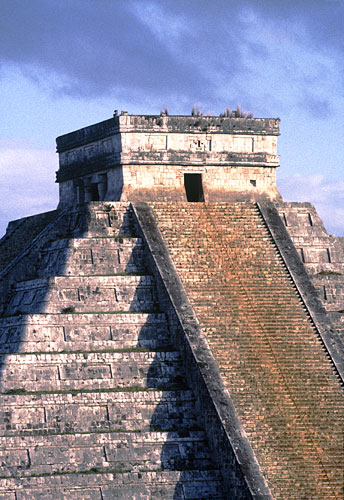 |
